


Your Complete Guide to Corporate Actions & How They Impact Stock Prices
Introduction
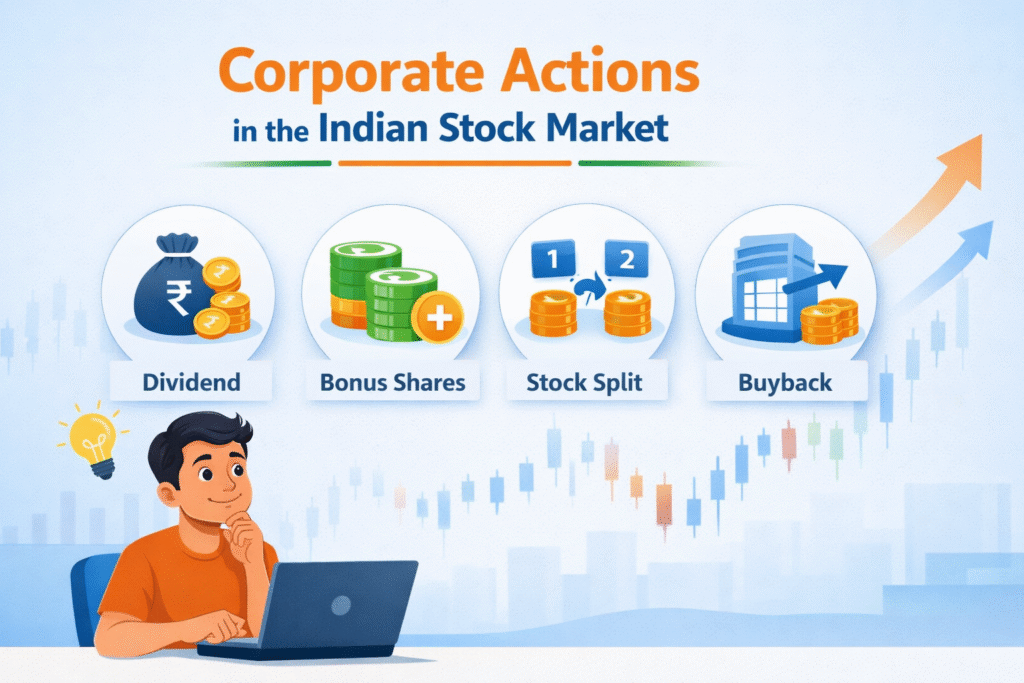
Corporate actions play a crucial role in the Indian stock market. Whether it is dividends, bonus shares, stock splits, or buybacks — each action signals a company’s financial health and influences investor sentiment.
For long-term investors, understanding corporate actions is essential because these events can create opportunities for passive income, portfolio growth, and strategic investment decisions.
This guide explains each corporate action in detail, how it affects stock prices, and what investors should watch in 2025.
1. What Are Corporate Actions?
Corporate actions are key decisions taken by a company’s board of directors that directly impact shareholders. These actions influence:
- Shareholder wealth
- Share price behavior
- Company financial structure
- Market sentiment
Corporate actions can be mandatory (affects all shareholders) or voluntary (shareholders choose to participate).
2. Types of Corporate Actions (Explained Simply)
A. Dividend
A dividend is a portion of the company’s profits distributed to shareholders.
Types of Dividends:
- Interim Dividend – Paid before fiscal year-end
- Final Dividend – Paid after the annual results
- Special Dividend – One-time large payout
- Stock Dividend – Paid in shares instead of cash
Why Companies Give Dividends:
- Strong cash flow
- Stable profits
- Shareholder reward
- Market confidence
How Dividends Impact Stock Price:
- On the ex-dividend date, stock price usually falls equal to the dividend amount.
- High dividends signal strong financial health.
B. Bonus Shares
Companies issue bonus shares to reward shareholders by giving extra shares for free, based on a ratio.
Example:
Bonus 1:1 → You get 1 share free for every 1 share owned.
Why Companies Issue Bonus Shares:
- To increase liquidity
- To make share prices more affordable
- To reward loyal shareholders
Impact on Share Price:
- Price reduces proportionally
- Market cap remains the same
- Shareholding increases → good for long-term investors
C. Stock Split
A stock split divides a company’s share into smaller shares to reduce its price.
Example:
Split from 1:5 → 1 share becomes 5 shares.
If price was ₹5,000, after split:
₹5,000 ÷ 5 = ₹1,000 per share.
Why Companies Split Shares:
- To make stock more affordable
- To increase liquidity
- To attract retail investors
Impact on Share Price:
- Price drops based on split ratio
- Total holding value remains unchanged
D. Buyback
A buyback is when a company purchases its own shares from the market or shareholders.
Reasons for Buyback:
- Company believes its stock is undervalued
- To reduce number of outstanding shares
- To boost EPS (Earnings per Share)
- To return surplus cash to shareholders
Impact on Stock Price:
- Demand for shares increases → price rises
- Positive sentiment if buyback is at a premium
3. Why Corporate Actions Matter to Investors
1. Income Generation
Dividends create passive income — especially valuable for retirees and long-term investors.
2. Portfolio Growth
Bonus shares and splits increase share quantities without extra investment.
3. Market Opportunities
Corporate actions often lead to temporary volatility, offering short-term trading opportunities.
4. Signals Company Strength
- Dividends → Strong cash flow
- Buybacks → Undervalued stock
- Bonus/Split → Confidence in growth
4. Key Corporate Actions to Watch (2025 Outlook)
(Illustrative categories — you can update monthly on your blog with fresh data.)
Sectors likely to announce dividends in 2025:
- Banking (ICICI Bank, HDFC Bank, SBI)
- FMCG (HUL, ITC, Nestlé)
- IT (TCS, Infosys)
Companies likely for bonus/split:
- Mid-cap pharma
- Specialty chemicals
- Fast-growing small caps
Buyback candidates:
- Cash-rich IT companies
- Conglomerates with surplus liquidity
(Always check official exchange filings before investing.)
5. Important Dates Every Investor Must Track
Corporate actions involve specific dates:
1. Announcement Date
Company declares the action.
2. Record Date
Investor must be in company records on this date to receive dividend/bonus/split.
3. Ex-Date
Buy stock before ex-date to be eligible.
4. Payment/Allotment Date
Dividend is credited or bonus/split shares are allocated.
6. How to Check Corporate Actions (Free Sources)
Investors can check announcements on:
- NSE website
- BSE website
- Company Investor Relations page
- SEBI filings
- Moneycontrol / Screener notifications
- Broker apps (Zerodha, Angel, Upstox)
7. How Traders Use Corporate Actions for Opportunities
1. Dividend Capture Strategy
Buy before ex-date → Sell after dividend announcement.
(Not always profitable — avoid chasing high dividends.)
2. Bonus/Split Rally
Stocks often rally before the event due to hype.
3. Buyback Arbitrage
Buy below buyback price → tender shares for profit.
Requires careful planning.
8. Risks & Misconceptions
Investors must be careful with:
1. High Dividend ≠ Good Company
A loss-making company can also declare dividends.
2. Bonus Issue ≠ Wealth Creation
Bonus only increases share quantity, not value.
3. Buyback Doesn’t Always Mean Growth
Sometimes companies use buybacks to manipulate EPS.
4. Stock Split Doesn’t Change Fundamentals
Only the number of shares increases — price adjusts.
9. Final Tips for Investors in 2025
✔ Do not buy stocks just for dividends or bonuses
✔ Check company fundamentals before investing
✔ Track ex-date and record date carefully
✔ Look for long-term value, not short-term hype
✔ Use corporate actions as additional signals, not main criteria
Conclusion
Corporate actions provide valuable information about a company’s financial health, liquidity, and confidence in future growth. Dividends reward investors, bonus shares and splits improve liquidity, and buybacks reflect management’s belief in the company’s value.
For long-term wealth creation, understanding these events can help you make smarter, more informed decisions in 2025 and beyond.


