


Every trader enters the stock market with one goal—to make profitable trades. However, option buying can quickly become expensive if you enter a trade without proper analysis.
Many beginners lose money not because their market view is wrong, but because they ignore essential factors like market trend, implied volatility (IV), strike price selection, expiry, and risk management.
Before buying any option, ask yourself one simple question:
“Have I checked everything?”
If the answer is no, this guide is for you.
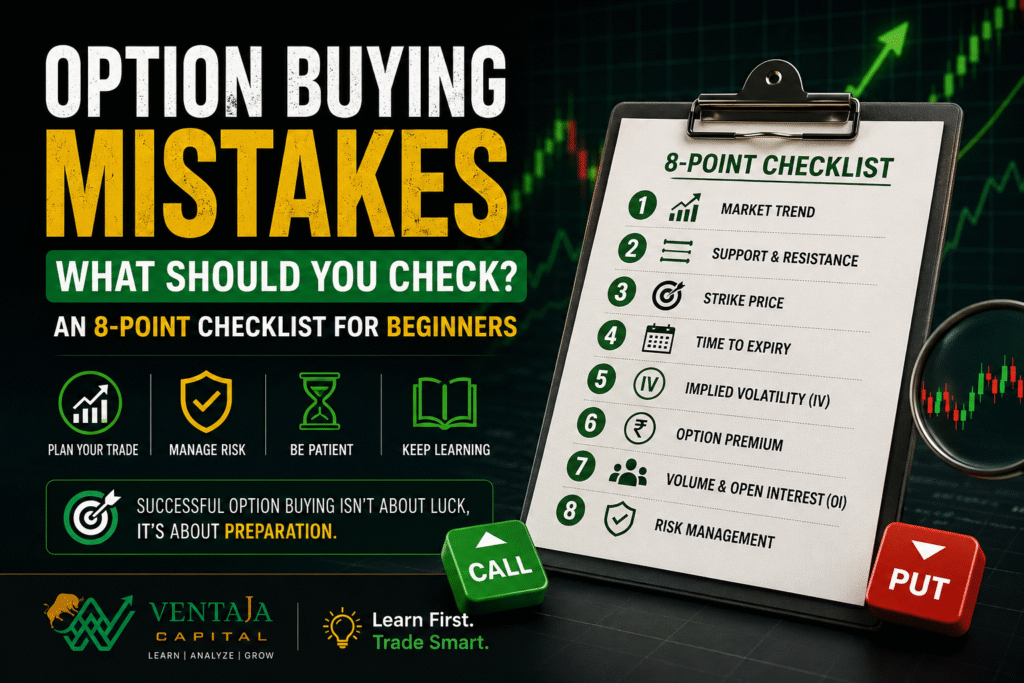
Here’s an 8-point checklist that every beginner should follow before buying an option.
Why Most Option Buyers Lose Money
Options are highly leveraged instruments. While they offer the possibility of significant returns, they also carry high risk.
Common reasons beginners lose money include:
- Buying options in the wrong market direction
- Choosing the wrong strike price
- Ignoring Implied Volatility (IV)
- Entering just before expiry
- Trading illiquid contracts
- Not using a stop loss
- Chasing cheap premiums
- Trading without a plan
Successful option buying is less about prediction and more about preparation.
- Check the Market Trend First
The first and most important rule is:
Trade with the trend—not against it.
Trying to catch market tops or bottoms often leads to losses.
Before buying an option, determine whether the market is:
- Bullish
- Bearish
- Sideways
Use indicators like:
- Moving Averages
- Higher Highs & Higher Lows
- Trendlines
- Price Action
Example:
If Nifty is making higher highs and higher lows, buying Call Options generally has a higher probability than buying Put Options.
Golden Rule:
Trend First. Trade Second.
- Identify Support and Resistance Levels
Many beginners buy Call Options directly below a strong resistance or Put Options directly above strong support.
This significantly reduces the probability of success.
Instead:
- Buy Calls near strong support during an uptrend.
- Buy Puts near strong resistance during a downtrend.
Support and resistance help you identify:
- Better entries
- Better exits
- Lower risk trades
- Choose the Right Strike Price
Selecting the correct strike price is just as important as predicting market direction.
Generally, beginners should prefer:
ATM (At-The-Money) Options
ATM options usually offer:
- Better liquidity
- Reasonable premium
- Balanced risk-reward
- Faster execution
Avoid buying very far OTM (Out-of-the-Money) options simply because they look cheap.
Cheap doesn’t always mean profitable.
- Check the Time to Expiry
Time plays a huge role in option pricing.
As expiry approaches, options lose value due to Time Decay (Theta).
This means:
- Less time = Faster premium erosion
- More time = Better flexibility
Beginners should avoid buying options just before expiry unless they have a clear intraday or short-term strategy.
Longer expiry contracts generally provide more breathing room for the trade to work.
- Check Implied Volatility (IV)
Implied Volatility (IV) indicates how expensive an option premium is.
High IV usually means:
- Premiums are expensive
- Expectations of larger price movement
- Higher risk of IV crush after events
Examples include:
- Budget announcements
- RBI policy meetings
- Earnings results
Buying options when IV is unusually high can reduce profitability even if the market moves in your direction.
Always compare current IV with historical levels before entering.
- Don’t Buy Just Because the Premium Looks Cheap
One of the biggest beginner mistakes is assuming:
Low Premium = Good Opportunity
In reality:
Low premium may indicate:
- Poor probability
- Far OTM strike
- Low liquidity
- Low chance of profit
Instead of focusing only on option price, evaluate:
- Market trend
- Strike selection
- Probability
- Risk-reward ratio
Value matters more than price.
- Check Volume and Open Interest (OI)
Liquidity is essential in options trading.
Before buying an option, always check:
Volume
Higher trading volume means:
- Easier entry
- Easier exit
- Better price execution
Open Interest (OI)
High Open Interest generally indicates:
- Better participation
- Stronger liquidity
- Reliable market activity
Low-volume contracts often have wider bid-ask spreads, making trades more expensive.
Always choose actively traded option contracts whenever possible.
- Never Ignore Risk Management
Even the best setup can fail.
That’s why every trade should include a predefined risk management plan.
Before entering any trade, decide:
- Entry Price
- Stop Loss
- Target Price
- Maximum Capital at Risk
Professional traders focus on protecting capital first.
Remember:
You don’t need to win every trade.
You only need to control your losses.
The Golden Rule of Option Buying
Before placing any options trade, ask yourself:
❌ No Trend?
Don’t Trade.
❌ No Plan?
Don’t Trade.
❌ No Stop Loss?
Don’t Trade.
Successful traders are disciplined traders.
Quick 8-Point Option Buying Checklist
Before buying any option, confirm the following:
✅ Market Trend is clear
✅ Support & Resistance identified
✅ Right Strike Price selected
✅ Enough Time to Expiry
✅ Implied Volatility checked
✅ Premium offers value
✅ Volume & Open Interest are healthy
✅ Entry, Target & Stop Loss planned
If even one of these is missing, reconsider the trade.
Common Option Buying Mistakes Beginners Should Avoid
Here are some of the most common mistakes new traders make:
- Trading without market confirmation
- Buying options near expiry without a strategy
- Ignoring IV before entering
- Selecting far OTM options because they’re cheaper
- Not checking liquidity
- Overtrading after a loss
- Risking too much capital on a single trade
- Trading without a stop loss
Avoiding these mistakes alone can significantly improve your trading discipline.
Final Thoughts
Successful option buying isn’t about predicting the market perfectly—it’s about following a structured process before every trade.
By checking the market trend, support and resistance, strike price, expiry, implied volatility (IV), premium, volume, open interest (OI), and risk management, you increase your chances of making informed trading decisions.
The best traders aren’t the ones who take the most trades—they’re the ones who consistently follow their rules.
Learn First. Trade Smart.
FAQs
What is the biggest mistake beginners make in option buying?
The most common mistake is buying options without checking the market trend, implied volatility, expiry, or risk management.
Should beginners buy ATM or OTM options?
Beginners generally benefit from At-The-Money (ATM) options because they offer better liquidity, balanced risk, and more consistent price movement than far OTM options.
Why is Implied Volatility (IV) important?
IV affects option premiums. Buying when IV is very high can lead to expensive premiums and potential losses due to IV contraction, even if the market moves in the expected direction.
Why is volume important in options trading?
Higher volume usually means better liquidity, tighter bid-ask spreads, and smoother order execution.
Is risk management necessary in option buying?
Absolutely. Setting an entry, target, and stop loss before every trade is essential for protecting capital and maintaining long-term consistency.


