


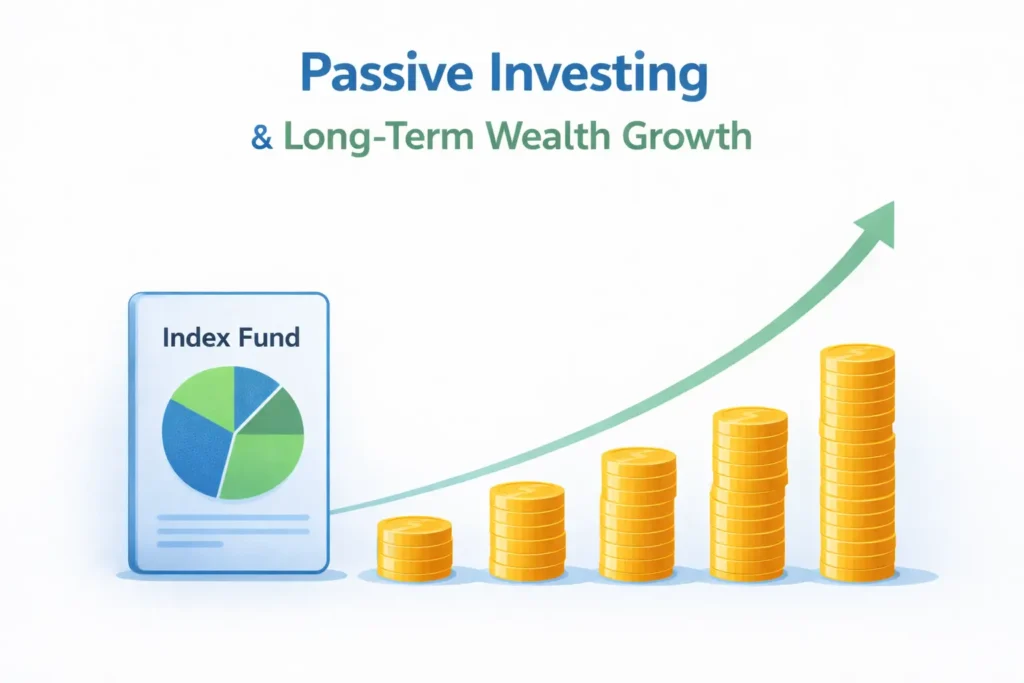
1. What Is Passive Investing?
- Passive investing means tracking the market instead of trying to beat it.
- It focuses on steady, low-cost, and disciplined investing in broad market indices.
- Popular benchmarks: Nifty 50, Sensex, S&P 500.
- Goal: Stable, long-term returns with less effort and emotion.
2. Understanding ETFs (Exchange-Traded Funds)
- ETFs are funds that hold multiple stocks or bonds and are traded like shares on the stock exchange.
- They replicate the performance of a chosen index, such as Nifty 50.
- Investors can buy/sell ETFs anytime during market hours.
- Advantages: Liquidity, transparency, low fees, and instant diversification.
3. What Are Index Funds?
- Index Funds are mutual funds that mirror a market index.
- Unlike ETFs, they are not traded intraday; purchases happen at the day’s NAV (Net Asset Value).
- Best for investors who prefer automatic SIP-based investing.
- Example: A Nifty 50 Index Fund holds all 50 companies from the Nifty 50 in the same proportion.
4. ETFs vs Index Funds — A Clear Comparison
Feature | ETF | Index Fund |
Trading | On exchange (real-time) | Once daily at NAV |
Expense Ratio | Lower | Slightly higher |
Liquidity | High | Moderate |
Demat Account | Required | Not required |
Best For | Active market users | Long-term passive investors |
5. How to Choose the Right ETF or Index Fund
✅ Pick a diversified index (Nifty 50, Nifty Next 50, or Sensex).
✅ Check Expense Ratio — lower fees mean better returns over time.
✅ Review Tracking Error — smaller is better.
✅ Ensure liquidity (for ETFs) — high trading volume is ideal.
✅ Choose a trusted AMC with a strong performance record.
6. Why ETFs and Index Funds Are Gaining Popularity
- Low-cost investing is outperforming many active strategies.
- Retail participation in passive funds is booming via SIPs.
- Transparency & diversification make them ideal for new investors.
- Global trend: Over 50% of U.S. assets are now in passive funds — and India is catching up fast.
7. Who Should Invest
- 🧍♂️ Beginners looking for easy, low-risk market entry.
- 💼 Professionals without time for constant research.
- 👨👩👧👦 Long-term wealth builders and retirement planners.
- 📉 Traders seeking to hedge against index movement.
8. Pro Tip
Start with a Nifty 50 or Sensex Index Fund via SIP.
Stay consistent for 5–10 years — and let compounding and market growth do the heavy lifting.
9. Final Thoughts
Smart investing is not about predicting markets — it’s about owning them efficiently.
ETFs and Index Funds offer a simple, affordable, and reliable path to build wealth and achieve financial freedom.


